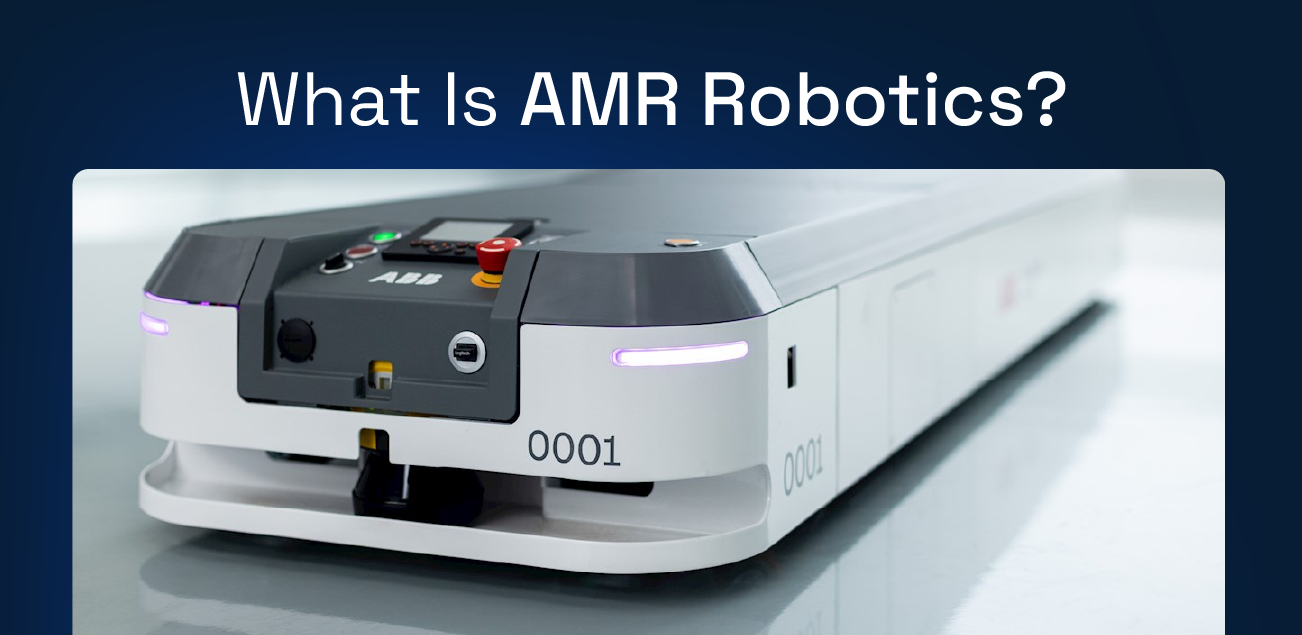
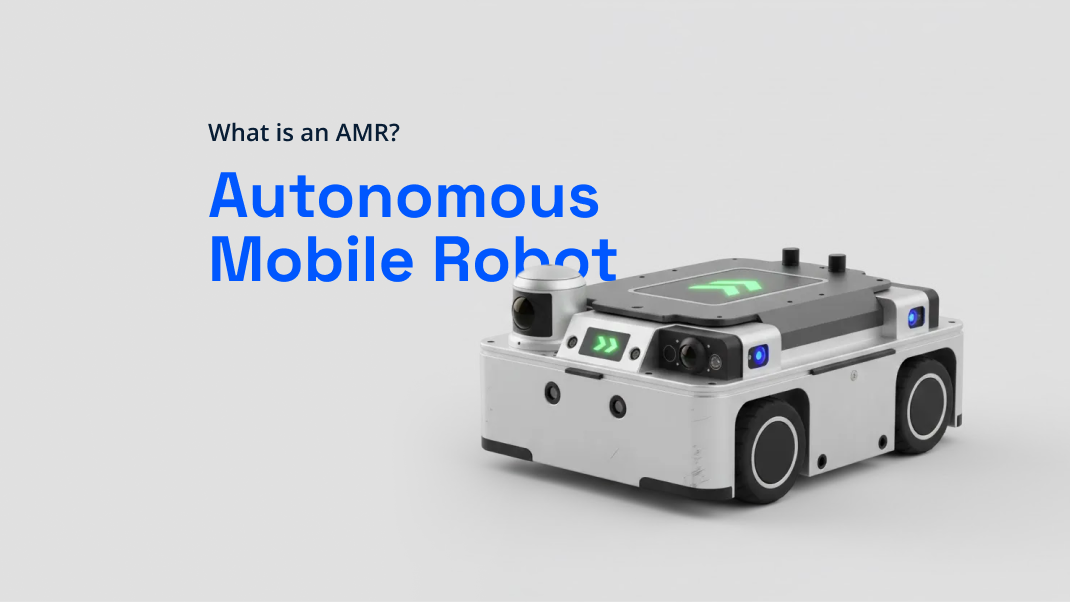
An Autonomous Mobile Robot (AMR) is a robot that can understand and navigate through its environment without continuous human guidance or fixed infrastructure. AMRs combine three essential capabilities: autonomous navigation using onboard sensors and AI, a mobile platform moving freely through facilities, and intelligent decision-making that adapts to changing conditions.
Unlike older Automated Guided Vehicles (AGVs) that follow magnetic strips or wires, AMRs use sophisticated sensors and artificial intelligence to perceive their surroundings, understand where they are, plan efficient paths, avoid obstacles dynamically, and adapt to environmental changes.
AMR stands for Autonomous Mobile Robot. It refers to robots that navigate and operate independently using onboard sensors, AI, and mapping technology — without needing fixed infrastructure like tracks or magnetic guides.
An AGV (Automated Guided Vehicle) follows fixed paths — magnetic tape, wires, or markers — and stops when its path is blocked. An AMR navigates freely using sensors and AI maps, routes around obstacles automatically, and requires no facility modification. AMRs deploy in days; AGVs can take weeks to install.
AMRs are used in warehouses and distribution centers, manufacturing facilities, hospitals, retail environments, and hospitality settings. Any facility requiring repetitive material transport between locations is a candidate for AMR deployment.
AMRs navigate using SLAM — Simultaneous Localization and Mapping. The robot builds a map of its environment using LiDAR and camera sensors, then continuously calculates its position within that map while moving. When obstacles appear, the AMR replans its route in real time.
AMRs perceive their environment through multiple sensor types. LiDAR creates 3D maps with centimeter-level precision. Cameras enable object recognition and human detection. Ultrasonic sensors detect nearby obstacles. IMU (Inertial Measurement Unit) tracks the robot's own movement and orientation. These sensors work together through sensor fusion — combining data streams into environmental understanding more accurate than any single sensor provides.
The core technology enabling AMR autonomy is SLAM. As AMRs explore facilities, they build detailed maps using sensor data. Once a map exists, AMRs continuously determine their position by comparing current sensor readings to stored maps. They perform mapping and localization simultaneously — adapting as environments change.
AMRs plan optimal routes considering distance, obstacle avoidance, traffic from other robots and people, charging needs, and task priorities. Modern AMRs replan continuously — if a person blocks the corridor or a door closes unexpectedly, the AMR instantly calculates an alternative route without human intervention.
Manufacturing: Moving components between assembly stations, transporting finished goods, delivering tools and materials to work cells.
Warehousing and Logistics: Transporting inventory from storage to picking stations, moving picked orders to packing and shipping, restocking inventory.
Healthcare: Delivering medications from pharmacies to nursing stations, transporting lab samples, moving linens and supplies.
Hospitality: Room service delivery in hotels, luggage transport, food and beverage service.
Retail: Inventory replenishment from back rooms to shelves, moving e-commerce orders within stores.
Navigation: AGVs follow fixed paths. AMRs navigate freely using sensors and maps. Flexibility: AGVs require facility modification. AMRs adapt to facilities as-is. Adaptability: AGVs stop when paths are blocked. AMRs route around obstacles automatically. Deployment: AGVs take weeks to install. AMRs deploy in days. Change management: AGV path changes require physical reconfiguration. AMR route updates happen through software.
Increased Productivity: AMRs work 24/7 without breaks, fatigue, or distractions, handling repetitive transport tasks and freeing humans for value-adding work.
Cost Reduction: Labor cost savings, reduced errors and damage, improved facility utilization through optimized workflows.
Safety Improvement: Reducing human exposure to hazardous transport tasks including heavy loads and forklift traffic.
Scalability: Easy to add robots as operations grow. Flexible deployment across multiple facilities and seasonal scaling.
Data and Analytics: AMRs generate operational data revealing bottlenecks, inefficiencies, and optimization opportunities invisible with manual processes.
AMR technology continues advancing rapidly. AI improvements are delivering better obstacle detection, path planning, and decision-making. Manipulation capabilities — robotic arms added to AMR platforms — are expanding what AMRs can do beyond transport. Outdoor operation through ruggedized AMRs is opening construction, agriculture, and outdoor logistics. Standardization across vendors is enabling multi-robot interoperability.
As technology improves and costs decline, AMRs will become increasingly standard across industries requiring physical security and logistics operations.